Showing posts with label non-fiction. Show all posts

Wednesday, March 16, 2016

Nonfiction Picture Book Challenge


Alyson Beecher over at Kid Lit Frenzy hosts a Nonfiction Picture Book Challenge and has a roundup every Wednesday. I love the encouragement to explore more non-fiction. My plan is to read at least 100 nonfiction picture books this year.

¡Olinguito, de la A a la Z! Descubriendo el bosque nublado
Olinguito, from A to Z! Unveiling the Cloud Forest

Summary: With lyrical text in both Spanish and English, we travel to the magical world of a cloud forest in the Andes of Ecuador. We discover the bounty of plants, animals, and other organisms that live there as we help a zoologist look for the elusive olinguito, the first new mammal species identified in the Americas since 1978. Not your usual ABC book, the alphabet works as an organizing feature and provides children with a vehicle to encounter rich vocabulary as they learn about a unique environment. Thoroughly researched and exquisitely illustrated with colorful, realistic images, the book is a visual delight while it provides a wealth of information. Backmatter includes articles about cloud forests and the discovery of the olinguito in 2013, and an extensive glossary with the scientific names of the species pictured. This is truly a unique book to treasure on many levels.

My Thoughts: The illustrations in this text are simply gorgeous. Delacre created scenes of the cloud forest using paintings and layers of mixed media. In the end notes, she explains that the "collage elements recreated the natural layers that define the forest." 

Speaking of the end notes, Delacre provided extensive notes about her research and her illustrations. She also provided more information about the cloud forest and the discovery of the olinguito. In addition, there is a glossary with images and a thorough accounting of the author's sources. I really appreciate having so much information provided beyond the text.

The text itself is rather wonderful too. Alphabet books can be marvelous and they can also feel forced and awful. Here the text is still lyrical and has substance even though she is trying to fit it into the format of the alphabet which can be quite tricky. 

This is a fantastic bilingual nonfiction text and I'm happy to add it to our collection.

Wednesday, July 22, 2015

Nonfiction Picture Book Challenge


Alyson Beecher over at Kid Lit Frenzy hosts a Nonfiction Picture Book Challenge and has a roundup every Wednesday. I love the encouragement to explore more non-fiction. I am thankful that she has this challenge because I know I have read more nonfiction texts as a result.

This will be a combination post with two books I've read recently and a few that are on my pile to be read soon. First for my vacation finds.


Astounding ABC produced by the Aga Khan Museum in Toronto

Goodreads Summary: From an arch and a lantern to an owl and a zoo, this ABC spelling book illustrates letters from the Latin alphabet with details from the Aga Khan Museum's superb collection of paintings, illuminated manuscripts, ceramics, metalwork, coins, and tiles from the 12th to 19th centuries. The board book offers an accessible introduction for very young children to the Museum's collection, showcasing a rich diversity of works from around the world, including Egypt, Sicily, India, Turkey, and Iran. Proving that learning can be fun, colourful, and exciting, Astounding ABC encourages children to explore the Museum's collection through animals, nature, historical figures, and a variety of artifacts.

My Thoughts: I loved this look at art from Muslim civilizations around the world. This book would be perfect to share before or after a visit to the Aga Khan Museum, but it is also a beautiful ABC book for children without physical access to the museum collection. The words used in the text are simple and the images that accompany them are vivid and interesting. I find it especially intriguing to see a king portrayed not with a crown, but a turban. It provides a look at artistic patterns and styles of dress that most of my students would not normally see in their daily lives.
 
The Aga Khan Museum

The Little RijksMuseum produced by the Rijksmuseum in Amsterdam

Goodreads Summary: More than 120 works of art or details from them can be seen in this Little Rijksmuseum. Their creators are Rembrandt, Vermeer, Steen, Breitner, Van Gogh and other famous artists. From angel to windmill and beetle to zebra, these and many more... allow a fascinating glimpse into the national treasure-house of the Rijksmuseum.

My Thoughts:  Again, this would be a wonderful book to share with children before or after a visit to the museum. It is so fun to visit a museum and then watch for specific works of art. It's also nice to look at the images and remember the ones that you saw on your trip. That's what I like about this book. It makes a great reminder. There are works by Rembrandt, Van Gogh, and Vermeer along with many others that are less familiar. Even without the visit though, anyone interested in art would love this bookish walk through the museum.

Books to Read Soon

 The Blue Whale by Jenni Desmond

 
The Call of the Osprey by Dorothy Hinshaw Patent with Photographs by William Muñoz


Wednesday, December 24, 2014

Nonfiction Picture Book Challenge


Alyson Beecher over at Kid Lit Frenzy hosts a Nonfiction Picture Book Challenge and has a roundup every Wednesday. I love the encouragement to explore more non-fiction. I am thankful that she has this challenge because I know I have read more nonfiction texts as a result.


This is a gorgeous book about a topic that never gets old. My students go back to the shark section of the library repeatedly. They are endlessly fascinating creatures. The illustrations in this book are fabulous and the information is from a different angle than I usually see. I have been to San Francisco many times and never knew that a white shark feeding area was so near. Seeing how and why they feed there kept me glued to the page. 

Here are two videos that show Katherine Roy creating the illustrations for the book. 


You won't want to miss this one! Happy reading. 

Wednesday, December 3, 2014

Nonfiction Picture Book Challenge - The Favorites


Alyson Beecher over at Kid Lit Frenzy hosts a Nonfiction Picture Book Challenge and has a roundup every Wednesday. I love the encouragement to explore more non-fiction. I am thankful that she has this challenge because I know I have read more nonfiction texts as a result.

In July I posted my favorites of the year at that point. I've read about 75 non-fiction picture books that were new to me this year (not including re-reads at school with my classes). Here are some of the standouts:


My favorites are a mixture of old and new. I'm so glad that there are such good quality nonfiction books available for our students and I love to share them.

Wednesday, November 19, 2014

Nonfiction Picture Book Challenge


Alyson Beecher over at Kid Lit Frenzy hosts a Non-fiction Picture Book Challenge and has a roundup every Wednesday. I love the encouragement to explore more non-fiction.

It's Native American Heritage Month so I have been highlighting a lot of books by and about Native Americans in the library. Here are some of the nonfiction picture books that I have enjoyed in the past year or so with a Native American focus.

We All Count: A Book of Cree Numbers by Julie Flett


Goodreads summary: Whether in the country or the city, creature or insect, plant or animal, a part of a big family or a small family, we all live together and we all take care of one another. We all count. (from back cover) 

In this board book, Cree/Metis author Julie Flett beautifully illustrates simple English phrases demonstrating Cree Culture. Along the way, readers can practice counting using the Cree language.

My thoughts: This is another quietly beautiful book by Julie Flett. I appreciate being able to learn about the Cree culture in this simple and interesting concept book. In the "About this book" section, Sherry Farrell Racette writes, "This book is not only for Cree children and their communities who can see themselves. We All Count is for all children to enjoy, because everyone is honored in this beautiful little book....." I agree wholeheartedly. I am glad it exists for Cree children, but also for any child and caregiver.

Cowboy Up! Ride the Navajo Rodeo by Nancy Bo Flood with Photos by Jan Sonnenmair


Goodreads summary: Celebrated author Nancy Bo Flood combines compelling first-person narrative poems with linked prose explanations to portray the dawn-to-dusk events and activities of a Navajo rodeo.

Photographer Jan Sonnenmair contributes dynamic action shots that show off the riders and ropers, the horses, bulls, and broncs, along with portrait photos of young rodeo participants.

My thoughts: I loved the blend of poetry and non-fiction. There are some fabulous photos here and it is great to see a Navajo sport up close. I think my students will enjoy learning about rodeo with this book.


When I Was Eight by Christy Jordan-Fenton & Margaret Pokiak-Fenton 
with illustrations by Gabrielle Grimard


Goodreads summary: "Nothing will stop a strong-minded young Inuit girl from learning how to read." Olemaun is eight and knows a lot of things. But she does not know how to read. She must travel to the outsiders' school to learn, ignoring her father's warning of what will happen there. The nuns at the school take her Inuit name and call her Margaret. They cut off her long hair and force her to do chores. She has only one thing left -- a book about a girl named Alice, who falls down a rabbit hole. 

Margaret's tenacious character draws the attention of a black-cloaked nun who tries to break her spirit at every turn. But she is more determined than ever to read. By the end, Margaret knows that, like Alice, she has traveled to a faraway land and stood against a tyrant, proving herself to be brave and clever. 

Based on the true story of Margaret Pokiak-Fenton, and complemented by stunning illustrations, "When I Was Eight" makes the bestselling "Fatty Legs" accessible to young children. Now they, too, can meet this remarkable girl who reminds us what power we hold when we can read.

My thoughts: I appreciate hearing first-hand accounts of the residential school era. This is a part of history that I did not know about when I was growing up. This is a picture book version of a portion of the book Fatty Legs which I also enjoyed. Having this part of history told through a child's eyes in a memoir brings it up close and makes it personal.


Greet the Dawn: The Lakota Way by S.D. Nelson


Goodreads summary: Pickup trucks and eagles, yellow school buses and painted horses, Mother Earth and Sister Meadowlark all join together to greet the dawn. They marvel at the colors and sounds, smells and memories that come with the opening of the day. Animals and humans alike turn their faces upwards and gaze as the sun makes its daily journey from horizon to horizon. 

 Dawn is a time to celebrate with a smiling heart, to start a new day in the right way, excited for what might come. Birds sing and dance, children rush to learn, dewdrops glisten from leaves, and gradually the sun warms us. Each time the sun starts a new circle, we can start again as well.

 All these things are part of the Lakota way, a means of living in balance. S.D. Nelson offers young readers a joyous way of appreciating their culture and surroundings. He draws inspiration from traditional stories to create Greet the Dawn. His artwork fuses elements of modern with traditional. Above all, he urges each of us to seize the opportunity that comes with the dawn of each new day.

My thoughts: Greet the Dawn - The Lakota Way is a beautiful book that shares the Lakota Way. According to the author, this way "offers a means of living in balance." S.D. Nelson provides an introduction explaining this way of life that is lived in a circle with humility and balance. I appreciated the mix of tradition and modernity in the book within the text and illustrations. He honors traditional patterns and imagery, but is also bringing a new vision to the work including playfulness with colors and even some cartoon elements among other things. Another part of this fusion is that he provides modern scenes along with timeless illustrations. The reader will know that this is not only about Lakota from long ago. On the title page we see a pickup truck amidst a grouping of tipis. There is also a fantastic spread with a big yellow school bus. Within this contemporary school type scene he includes colorful patterns along the road and pictographic images in the sky that point to the Lakota heritage. 

The text is also a fusion of old and new. Through the simple poetic lines, Nelson is sharing the many teachings that have influenced his life. In a note at the end, Nelson tells of the people who have provided this teaching including Black Elk and many others. I appreciated that he points to the sources. The text also includes several songs in the Lakota language that he notes are from Teton Sioux Music. I always appreciate seeing other languages within picture books.

I highlighted this book earlier in the year here.

Giving Thanks: A Native American Good Morning Message by Chief Jake Swamp and illustrated by Erwin Printup Jr.


Goodreads summary: A traditional Iroquois celebration of the beauty and spirit of Mother Earth, as told by a contemporary Mohawk chief.

My thoughts: This book is a beautiful way to introduce thankfulness. Each page expresses thankfulness for the many resources and wonders of Mother Earth. It has a tone of awe and wonder for the way that the world provides for us. I love to use this to begin discussion of thanks and expressing thanks. It is also a great way to show that Thanksgiving is more than pilgrims and turkey because many people express thankfulness outside of the traditional holiday.


These four board books are bright, colorful and capture the attention of children. To learn more about them, visit the Head Start website. I've shared these books with students even beyond pre-school because they have great information and three of them show modern Ojibwe children and culture. Our Journey is also a book that shares a greeting of the day like Giving Thanks and Greet the Dawn so it works well with either or both of those texts.

Any of these books would work for Native American Heritage Month, but they are also excellent books to share throughout the year. 

Wednesday, August 27, 2014

Nonfiction Picture Book Challenge


Alyson Beecher over at Kid Lit Frenzy hosts a Non-fiction Picture Book Challenge and has a roundup every Wednesday. I love the encouragement to explore more non-fiction.

This week I finally got to read The Cosmobiography of Sun Ra by Chris Raschka. Wow! Sun Ra, or Herman Poole Blount as he was named at birth, was a very interesting individual. This picture book biography is a great blending of music, art, and facts about an imaginative and creative man. I was glad to find some recordings of his music online. Jazz was inventive and left a lot of room for experimentation. Sun Ra was all over that. Listen and observe in the trailer below.

 
I was happy to find this great article/author interview over at the Smithsonian website. I'm looking forward to sharing this bright and interesting biography with students and the art teacher.

Wednesday, June 18, 2014

Nonfiction Picture Book Challenge


Alyson Beecher over at Kid Lit Frenzy hosts a Non-fiction Picture Book Challenge and has a roundup every Wednesday. This week I read quite a few of the new biographies of women that I bought for my elementary library. Unless otherwise noted, the images and summaries are from IndieBound.


Title: Shining Star: The Anna May Wong Story
Author: Paula Yoo
Illustrator: Lin Wang
Publisher: Lee and Low

Summary: Born in 1905, Anna May Wong spent her childhood working in her family's laundry in Los Angeles s Chinatown. Whenever she could afford it, Anna May slipped off to the movies, escaping to a world of adventure, glamour, and excitement. After seeing a movie being filmed in her neighborhood, young Anna May was hooked. She decided she would become a movie star.

Anna May struggled to pursue an acting career in Hollywood in the 1930s. There were very few roles for Asian Americans, and many were demeaning and stereotypical. Anna May made the most of each limited part. She worked hard and always gave her best performance. Finally, after years of unfulfilling roles, Anna May began crusading for more meaningful roles for herself and other Asian American actors. 

Anna May Wong the first Chinese American movie star was a pioneer of the cinema. Her spirited determination in the face of discrimination is an inspiration to all who must overcome obstacles so that their dreams may come true."

My thoughts: I really appreciate learning about people who have done amazing things. I am so happy to find biographies that shed light on people that I may otherwise have missed. Anna May was a persistent person and she was also a trailblazer. In her time, and unfortunately sometimes still today, Asian characters were usually played by non-Asians. She had to compromise early in career and take parts she didn't necessarily like, but later she stood her ground and only took positive roles. She fought for change. This would be an excellent book to introduce when talking about racism or white washing in the media. It is also simply a very interesting biography.


Title: Flying Solo: How Ruth Elder Soared Into America's Heart
Author: Julie Cummins
Illustrator: Malene R. Laugesen
Publisher: Roaring Brook Press

Summary: In 1927, airplanes were a thrilling but dangerous novelty. Most people, men and women, believed that a woman belonged in the kitchen and not in a cockpit. One woman, Ruth Elder, set out to prove them wrong by flying across the Atlantic Ocean. Ruth didn't make it, crashing spectacularly, but she flew right into the spotlight and America's heart. This is the story of a remarkable woman who chased her dreams with grit and determination, and whose appetite for adventure helped pave the way for future generations of female flyers.

My thoughts: There have been many books about women flying, but I never really get tired of them. I love seeing Ruth's spunk. It's also fun to see that even as she was doing these dangerous things, she still enjoyed evening gowns and dressing up. I especially enjoyed the spread at the end that highlights many other women pilots and there is information about them in the author's note which is thorough and informative.


Title: Baby Flo
Author: Alan Schroeder
Illustrator: Cornelius Van Wright and Ying-Hwa Hu
Publisher: Lee and Low

Summary: Straight up: Florence was a remarkable child, and that’s a fact. 

Pint-sized dynamo “Baby Florence” Mills was singing and dancing just about as soon as she could talk and walk. She warbled a tune while her mama did laundry. Everywhere Flo went, she strutted through the streets of Washington, D.C. with a high-steppin’ cakewalk. Flo’s mama and daddy knew they had a budding entertainer in the family, so they entered Florence in a talent contest. Baby Flo went on to become an international superstar during the Harlem Renaissance—but first she had to overcome a case of stage fright and discover that winning wasn’t everything. 

Here is the spirited story of that spunky young girl learning to chase her dreams with confidence. A sensation in her time, Baby Flo is back, dancing and singing her way into hearts and history.

My thoughts: I loved seeing the joy Flo found in singing and dancing. It reminded me of Josephine Baker. Florence Mills appears to have had a flat out love of singing. It's fun to see a child succeeding and having fun while accomplishing her goals. The book was very upbeat and the story concluded while Flo was still young. The author's note tells about the rest of her life. While it was mostly positive, I found the end of her life rather tragic as she died at thirty-one. The photograph that shows thousands of people at her funeral definitely shows that she touched many people's hearts and lives.  


Title: Red Bird Sings: The Story of Zitkala-Ĺ a, Native American Author, Musician and Activist
Authors: Gina Capaldi & Q.L. Pearce
Illustrator: Gina Capaldi
Publisher: Carolrhoda Books

Summary: This is a picture book biography of Zitkala-Ĺ a, born Gertrude Simmons Bonnin, a Native American woman at the turn of the nineteenth century. Zitkala-Ĺ a was a writer, editor, musician, teacher, and political activist in a time when even basic education was uncommon among Native Americans.

My thoughts: I really appreciated finding this biography of a Yankton Sioux woman. It is great to see her strength, persistence, and her contributions to the world. Through this book, readers learn a bit about what it was like for Zitkala-Ĺ a to be separated from her family and culture while she was educated at a residential school. We see the conflict as she learns the white ways and begins to lose her feeling of belonging with her family and culture. Books, music and writing were places that she found comfort. 

In adulthood, Zitkala-Ĺ a worked for equality for women and Native Americans. She became an activist and supported American Indian issues. She also received national acclaim for her writing and music. 

The book made me want to read Zitkala-Ĺ a's own works though. I wondered a few times about the word choice I was seeing - whether they were her own or those of the authors since the authors note explains that they have "reworked her language and substituted modern phrasing for clarity." One example of this is on pg. 21 when she was giving a speech and the text says, "I spoke of the noble Indian and urged my audience to accept us as equals." It's not necessarily a big thing, but I wondered if she used the phrase "noble Indian." It is possible since that is a phrasing that was often used. Another instance is p. 14 when the text says, "I was neither a small girl nor a tall one, neither a wild Indian or a tame one." These instances definitely made me curious to find her own words. Besides, she won awards for her speeches and writing, so I am wanting to experience the real deal now.  -- Cover image and summary via Goodreads

I am happy to have all of these illuminating biographies available for my students and am excited to share them next year.

Wednesday, June 11, 2014

Nonfiction Picture Book Challenge


Alyson Beecher over at Kid Lit Frenzy hosts a Non-fiction Picture Book Challenge and has a roundup every Wednesday. This week I was working on my Latin@s in Kid Lit reading challenge so all of these books are written by a Latin@ author and/or have a Latin@ focus. All images and summaries are via IndieBound.


Author: George Ancona

Summary: Want to grow what you eat and eat what you grow? Visit this lively, flourishing school-andcommunity garden and be inspired to cultivate your own. At an elementary school in Santa Fe, the bell rings for recess and kids fly out the door to check what’s happening in their garden. As the seasons turn, everyone has a part to play in making the garden flourish. From choosing and planting seeds in the spring to releasing butterflies in the summer to harvesting in the fall to protecting the beds for the winter. Even the wiggling worms have a job to do in the compost pile! On special afternoons and weekends, neighborhood folks gather to help out and savor the bounty (fresh toppings for homemade pizza, anyone?). Part celebration, part simple how-to, this close-up look at a vibrant garden and its enthusiastic gardeners is blooming with photos that will have readers ready to roll up their sleeves and dig in.

My Thoughts: Last year I read this review on the blog The Nonfiction Detectives. From their review I believed that this would be an excellent book for our school since we have a school garden also. I immediately purchased it, but didn't get around to reading it until this week. It's Our Garden combines simple yet informative text with fantastic photos and crayon illustrations created by the students. It is a gorgeous book that demonstrates the work, benefits and excitement of having a school garden. I can see this being a great introduction for our younger students before they begin working in the garden. It would pair well with Farmer Will Allen and the Growing Table.


Title: Frida
Author: Jonah Winter
Illustrator: Ana Juan

Summary: This long-awaited companion to Jonah Winter's acclaimed DIEGO features the paintings of young Spanish artist, Ana Juan. This stunning picture book is the perfect gift for art enthusiasts of all ages. When her mother was worn out from caring for her five sisters, her father gave her lessons in brushwork and color. When polio kept her bedridden for nine months, drawing saved her from boredom. When a bus accident left her in unimaginable agony, her paintings expressed her pain and depression - and eventually, her joys and her loves. Over and over again, Frida Kahlo turned the challenges of her life into art. Now Jonah Winter and Ana Juan have drawn on both the art and the life to create a playful, insightful tribute to one of the twentieth century's most influential artists. Viva Frida! 

My Thoughts: I loved the fancifulness in the illustrations. The illustrator explained that she used elements from Mexican folk art that Frida would have seen in her childhood. It gave the story an added bit of creativity that seemed in keeping with Frida's own imagination. For me the illustrations take this book to a higher level. They really are unique and surreal. 

The author did an excellent job of explaining her very complex life in a way that young children can understand. He also kept it rated G. He described a woman who flourished despite the hardships she endured. The author's note included this line, "She has specifically been an inspiration to women artists, who have found in Kahlo's strength, courage, and pizzazz an example of how to thrive as a woman in an art world dominated by men." I ran across an interview with the author. The focus isn't this book, but definitely delves into why he chooses to focus on famous people of color in his books. It was a fascinating read.


Illustrator: John Parra

Summary: In this lively picture book, children discover a world of shapes all around them: rectangles are ice-cream carts and stone metates, triangles are slices of watermelon and quesadillas. Many of the featured objects are Latino in origin, and all are universal in appeal. With rich, boisterous illustrations, a fun-to-read rhyming text, and an informative glossary, this playful concept book will reinforce the shapes found in every child's day!

My Thoughts: This is a bouncy rhyming book that offers examples of many different shapes. The examples are often part of Latin@ culture and are usually fun. It does include a glossary of the Spanish words used in the text in case a reader is not certain about the meaning though usually the illustrations assist with that. This will be a concept book that will be great to use in the primary grades. I can't wait to share it.


Author/Illustrator: Duncan Tonatiuh

Summary: Almost 10 years before "Brown vs. Board of Education," Sylvia Mendez and her parents helped end school segregation in California. An American citizen of Mexican and Puerto Rican heritage who spoke and wrote perfect English, Mendez was denied enrollment to a "Whites only" school. Her parents took action by organizing the Hispanic community and filing a lawsuit in federal district court. Their success eventually brought an end to the era of segregated education in California.

My Thoughts: This is a very important part of our history that is not often discussed. Students may hear of Brown vs. Board of Education, but this happened earlier and in some ways paved the way for that ruling. I knew of this case before, but I taught in California or I probably wouldn't have. The story is well told and includes many details that add a lot. To find out that there were signs in business that said, "No Dogs or Mexicans Allowed" could be eye-opening for many readers. 

Tonatiuh explains that many people pulled together from all around the country to help desegregate the schools in California. These people included the National Association for the Advancement of Colored People, the Japanese American Citizens League, and the American Jewish Congress among others. I love the quote attributed to Felícitas, Sylvia's mother, "Cuando la causa es justa, los demás te siguen. When you fight for justice, others will follow" (p 33).

As I was reading though, I was thinking about the project that Michelle Norris has been tweeting about, Segregation Now, that has investigated the resurgence of segregated schools. I wondered if this book would have students thinking that segregation happened a long time ago and then it was stopped forever. That might be true if readers stop with the story, but in his author's note, Tonatiuh addresses the fact that unfortunately this fight is still relevant. That note and the other materials at the end are very helpful. They include photographs of the family and schools involved. He also included a glossary that includes many of the legal terms among other things. The Bibliography is very thorough and he also included an index.  

I will be recommending this book to my teachers, students and many others. I think it is a part of our country's history that everyone should know about. I also believe that it is all too relevant right now. It will be helpful for civil rights studies and would pair up well with Through My Eyes or The Story of Ruby Bridges

One final note, if you have read the middle grade book Sylvia & Aki, this Sylvia is the same Sylvia that story is based on.

Extras:
If you are interested in the illustrations, Tonatiuh explains his digital collage process in the following video.


Julie Danielson (from the blog 7 Impossible Things Before Breakfast) had a chance to interview the author for Kirkus here. She followed up after the interview over at her blog and that includes images of some of his preliminary sketches. Both posts are quite interesting.

What nonfiction has caught your attention lately?

Wednesday, May 21, 2014

Non-fiction Picture Book Challenge


Hiromi's Hands by Lynne Barasch has been one of the books that I have shared with students during Asian-Pacific American Heritage Month. I love this biography and my students stay very engaged throughout. The book touches on immigrants honoring their heritage while also adopting some of the culture of a new country. I also appreciate the fact that Hiromi was breaking into a male dominated career. The video below is not for children, but it was interesting to hear from Hiromi herself. It's interesting that the author chose not to address Hiromi's difficulty with school and that she dropped out of high school. Also, the book made it sound more like Hiromi was pestering her dad to let her work with him, but in this video, she says he asked her if she would like to work at the restaurant after she had dropped out of school and was just hanging out at home. The biography was a bit more rosy than reality I think, but I imagine that often happens with children's books.

Goodreads summary: The true story of Hiromi Suzuki, a Japanese American girl who defied tradition to train at her family s restaurant, and who became one of the first female sushi chefs in New York.


We Feel Good Out Here by Julie-Ann Andre and Mindy Willett is a book that I will be sharing with my students. Julie-Ann shares how her family lives in the Northwest Territiories of Canada. Their lives are closely connected to the nature that surrounds them. The book is part of a series, "The Land in Our Storybook" and I want to read more of them.

Goodreads summary: In "We Feel Good Out Here," Julie-Ann shares her family's story and the story of her land-"Khaii luk," the place of winter fish. As Julie-Ann says, "The land has a story to tell, if you know how to listen. When I travel, the land tells me where my ancestors have been. It tells me where the animals have come and gone, and it tells me what the weather may be like tomorrow." Her home is an important part of who Julie-Ann is. She wants to help make sure that her environment is healthy, so it can continue to tell its story to her children and their children.


Yes! We are Latinos! is not technically a picture book, but it does have some illustrations. I couldn't leave it out because it is one of my favorite non-fiction books that I've read recently. I loved hearing from so many different perspectives and learning the history of so many people.

Goodreads summary: Juanita lives in New York and is Mexican. Felipe lives in Chicago and is Panamanian, Venezuelan, and black. Michiko lives in Los Angeles and is Peruvian and Japanese. Each of them is also Latino.

Thirteen young Latinos and Latinas living in America are introduced in this book celebrating the rich diversity of the Latino and Latina experience in the United States. Free-verse fictional narratives from the perspective of each youth provide specific stories and circumstances for the reader to better understand the Latino people’s quest for identity. Each profile is followed by nonfiction prose that further clarifies the character’s background and history, touching upon important events in the history of the Latino American people, such as the Spanish Civil War, immigration to the US, and the internment of Latinos with Japanese ancestry during World War II. Alma Flor Ada and F. Isabel Campoy’s informational yet heartwarming text provides a resource for young Latino readers to see themselves, while also encouraging non-Latino children to understand the breadth and depth of the contributions made by Latinos in the US. Caldecott Medalist David Diaz’s hand-cut illustrations are bold and striking, perfectly complementing the vibrant stories in the book.

Wednesday, May 14, 2014

Non-Fiction Picture Book: Summoning the Phoenix

Title: Summoning the Phoenix: Poems and Prose About Chinese Musical Instruments
Author: Emily Jiang
Illustrator: April Chu
Publisher: Shen's Books
Pages: 32
Review Copy: From Publisher
Availability: On Shelves Now

Review: Before a reader even opens the book, it is obvious that this is something more than a typical informational book. The cover hints at fantasy and magic. It also demonstrates the richness and attention to detail that is found in the artwork throughout the book. The artist explains her illustration process on her blog using one of my favorite spreads from the book. Obviously, the art impressed me, but so did the text.

The text is in two parts, something that I seem to be noticing a lot lately like in Do You Hear the Nesting Bird? and Mama Built a Little Nest. One part is the poems that are telling about the preparations children are making as the time draws near for their orchestra concert. This is not a typical orchestra concert however. The orchestra is made up of musicians playing Chinese instruments. We find out in the author's note that this type of orchestra has only been around for about fifty years and traditionally the instruments would have been played alone, as an accompaniment or in a small group. The book is a blend of modern and ancient.

Readers may choose to go through the book simply reading the brief poems and looking at the illustrations. This could be especially helpful if the reader is young and not ready for the smaller print and length of the informational text. The poems are written from a child's perspective and are pretty  easy for children to understand and enjoy - particularly if they play instruments themselves. I think they will be delighted by "Warming Up" which features fish lips and a pretend kiss. This is accompanied by a wonderful illustration of a girl making a fabulous fish face. Another one that will be sure to engage children is "Friendly Competition." In this poem, two musicians play as fast, long, and loud as they can trying to outdo each other. This results in purple-blue faces. I imagine it would be fun to act this out with or without instruments. The playfulness in the poems is refreshing and often brought a smile to my face.

While the poems are interesting and fun to read, the second part of text, the informational portion, adds a lot to the book and shouldn't be entirely skipped. Even with a young child, I would share at least some of the information. Each instrument is named (with pronunciation) and Jiang explains how it is put together. She also tells about how the instrument is played and describes the sound. What really caught my imagination though were the legends and little tidbits about some of them. That was where the phoenix came into play. Legend says that the xiao, a flute made of bamboo,  has magical powers that allowed it to summon creatures such as a dragon and a phoenix.

I am looking forward to sharing this book with our students. Music is something that many children connect with and the format and illustrations are sure to capture their attention and allow for interaction. I would definitely recommend this book for purchase. I am also looking forward to the album, Songs for Summoning the Phoenix, that is scheduled to be published also. That was the only thing that was missing for me. I wanted to actually hear the instruments as I read. I hope you get a chance to experience this book for yourself. It's a treat.

Other reviews & interviews:
Kirkus - review
The Pirate Tree - review
Mary Robinette Kowal - interview/guest post
Whatever - interview/guest post

Wednesday, May 7, 2014

Nonfiction Picture Book Challenge


Alyson Beecher over at Kid Lit Frenzy hosts a Non-fiction Picture Book Challenge and has a roundup every Wednesday. I am late getting this posted, but wanted to share a few books that focus on fine arts.


Much like in her earlier and shorter book Hands, Ehlert shares her own art journey in this scrapbook of her life. Both books explain how her family nurtured her artistic talent. The Scraps Book, goes further into her adult art life and shows even more. Seeing her process is fascinating. Ehlert does such a good job of keeping things simple yet engaging.  


Music Everywhere! combines amazing photographs with easy to read text about instruments and music making from around the world. I appreciated the specificity when talking about the people who are in the photos or who traditionally use the instruments. Individual groups of people are named rather than simply saying something or someone is from Africa. The specific country or even tribe is given. The pictures and descriptions are likely to inspire readers to create some music of their own or hunt down examples on the Internet. At the end, there are also simple instructions for making some musical instruments too.


The other books were library books, but this final book, Summoning the Phoenix, was provided by the publisher (Lee and Low Books). I will post a full review within the coming week. The illustrations are wonderful and it includes two different sets of text. On each page, a Chinese instrument is highlighted through a poem and a few paragraphs of description. One could read the poetry all the way through or choose to read the prose or read both together. I really enjoyed the fact that traditions and legends about the instruments were included. I wanted to track down all of the instruments online and hear how they sound. 

-- Cover images are from Indie Bound

Wednesday, April 23, 2014

Non-fiction Picture Book Wednesday


Alyson Beecher over at Kid Lit Frenzy hosts a Non-fiction Picture Book Challenge and has a roundup every Wednesday. I am giving it a try for the first time.

Here are some of the best non-fiction picture books I have read in the past week or two.


Grandfather Gandhi by Arun Gandhi & Bethany Hegedus and illustrated by Evan Turk is a picture book memoir. I have upper grade teachers asking for memoirs for their literature units and this is one I can certainly hand to them enthusiastically. The text has a positive and powerful message about anger and the illustrations are fabulous.


Mama Built a Little Nest by Jennifer Ward and illustrated by Steve Jenkins is another book with fantastic illustrations. Steve Jenkins always wows me. The book is set up to have a simple rhyming text as one portion paired with a paragraph or two of informational text about each of the types of birds and the varieties of their nest styles. I found it fascinating.


Wolfsnail: A Backyard Predator by Sarah C. Campbell and illustrated by Sarah C. and Richard P. Campbell is exactly what narrative non-fiction for young readers should be. It is compelling and tells a story filled with facts, but not so many that it is overwhelming or boring for young readers. It won a Geisel honor and I would love more books like this.

Have a great week!

Wednesday, April 2, 2014

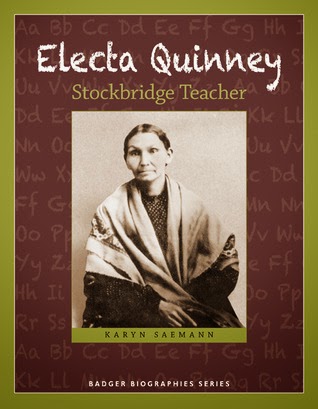
Review: Electa Quinney: Stockbridge Teacher

Title: Electa Quinney: Stockbridge Teacher
Author: Karyn Saemann
Publisher: Wisconsin Historical Society Press
Pages: 112
Availability: First published March 4, 2014
Review Copy: Publisher

Summary: Electa Quinney loved to learn. Growing up in the early 1800s in New York, she went to some of the best boarding schools. There she learned how to read, write, and solve tough math problems—she even learned how to do needlework. Electa decided early on that she wanted to become a teacher so she could pass her knowledge on to others. But life wasn’t simple. Electa was a Stockbridge Indian, and her tribe was being pressured by the government and white settlers to move out of the state. So in 1828, Electa and others in her tribe moved to Wisconsin. Almost as soon as she arrived, Electa got to work again, teaching in a log building that also served as the local church. In that small school in the woods, Electa became Wisconsin’s very first public school teacher, educating the children of Stockbridge-Munsee Band of the Mohican Indians as well as the sons and daughters of nearby white settlers and missionaries. Electa’s life provides a detailed window onto pioneer Wisconsin and discusses the challenges and issues faced by American Indians in the nineteenth century. Through it all, Electa’s love of learning stands out, and her legacy as Wisconsin’s first public school teacher makes her an inspiration to students of today. -- Cover image and summary via Goodreads


Review: Last summer I attended the American Indian Studies Institute and while I was there found out that the Wisconsin Historical Society was planning to publish this biography. Since I was able to visit the museum on the Mohican reservation and learn a little about Electa Quinney, I was eager to finally read the finished product. This is a great addition to the Badger Biographies series. I appreciate that the people chosen for the series are from so many different walks of life and there is a fairly even mix of male and females.

Though this may appear to be a book written only for Wisconsin readers, Electa was born in New York and the book traces the path she took to Wisconsin and then to Indian Territory and back again so it covers a lot of ground. Saemann explains the reasons for the movement of the Mohican Nation and the includes history of other nations as they were forcibly moved into the Indian Territory too. This book would be a great overview of American Indian history regardless of a reader's geographical location. 

Another positive aspect of the book is how the author explains that, "Understanding Electa's life is like working on a jigsaw puzzle." This is a great analogy. The research that was done for the book helped to uncover some of the details of her life, but much is missing. Saemann fills in some of the missing pieces with possibilities, but lets the reader know when there are holes. I think students will benefit from knowing that we can't always "google" something and know all of the answers. Sometimes in history there are gaps that may never be filled.

Like the other books in this series, the layout of the book is much like a textbook. There are many photos and other images scattered throughout and the text has a sufficient amount of white space around it so that young readers won't be overwhelmed. There are also many words in bold text that include definitions at the bottom of the page.

Electa's childhood is explained in addition to her positive boarding school experience at a Quaker school. Included with this is a history of the Stockbridge tribe and its move to Wisconsin. Readers will find that the Stockbridge families were living in houses made of logs with barns and farms. Once Electa moved to Indian Territory, we also find out about the first Indian newspaper in the United States - The Cherokee Phoenix which was a bilingual paper. Details of this kind have the potential to challenge beliefs that readers may have about American Indians.

Electa Quinney seems to have been a woman who valued learning and teaching and I am glad we have this record of her life. More than that though, I am happy to see the broader history of the Mohican and Cherokee Nations that the book encompasses. This will be an excellent addition to libraries throughout Wisconsin and beyond. I am eager to share it with my staff and students.

Sunday, March 30, 2014

Review: The Pot that Juan Built

Title: The Pot That Juan Built
Author: Nancy Andrews-Goebel
Publisher: Lee & Low Books
Pages: 32
Availability: On shelves now
Review Copy: Library

Summary: Written in the form of “The House That Jack Built” and accompanied by explanatory material, this celebratory story is also the tale of the village of Mata Ortiz and its people. Juan’s pioneering work has transformed Mata Ortiz from an impoverished village into a prosperous community of world-renowned artists.

With vibrant illustrations by Caldecott Medal winner David Diaz, The Pot That Juan Built is sure to enlighten all who are fascinated by traditional art forms, Mexican culture, and the power of the human spirit to find inspiration from the past. -- Cover image and summary via IndieBound

Review: This book captures me on many levels. There is the mimicry of "The House That Jack Built" so it is a great addition to a unit on cumulative stories. There is a wonderful non-fiction component, so it can be paired with biography or "how-to" units and of course the art component means that this book would be fabulous with a pottery unit too. On top of all of those thematic possibilities, the illustrations are dazzling in themselves. David Diaz uses bold colors and design that captures readers.

My students immediately began to chime in on the rhyming portion of the text. They especially loved the line, "Before it was baked in the cow manure fire." Each two page spread has a bit of the rhyme and the facing page has a brief explanation to go along with it. This is where the details are explained like the fact that Juan does in fact gather cow manure and uses it as the fuel for the fire.

My students were fascinated to learn that this story is about a real person and there is a website that shows some of the pictures from the information section at the end of the book in addition to even more pictures of his actual work.

To see that one man taught himself how to create pots of such beauty using only the natural materials from the land around him is pretty amazing. That he shared this knowledge with his community so they could also create these kinds of pots is even more inspiring. My third graders were quite impressed with his abilities and also found the rhyme to be quite fun. It is a joy to be able to share such a unique non-fiction text with my students.

After using the book in lessons, I also found several videos online so in the future we will also get to hear from Juan Quezada himself.


I will be recommending this book to many people in the future.